Everything Is at Its Acme
Gracián wrote in 1647 that the world had peaked and the old rules no longer worked. Every generation since has said it. The question is who crosses.
I am reading Baltasar Gracián slowly, one maxim at a time, and writing about the ones that will not leave me alone. There are three hundred of them, so this will take a while.
The book came out in 1647. Gracián was a Spanish Jesuit writing about how to get through the world. His first maxim opens with three words.
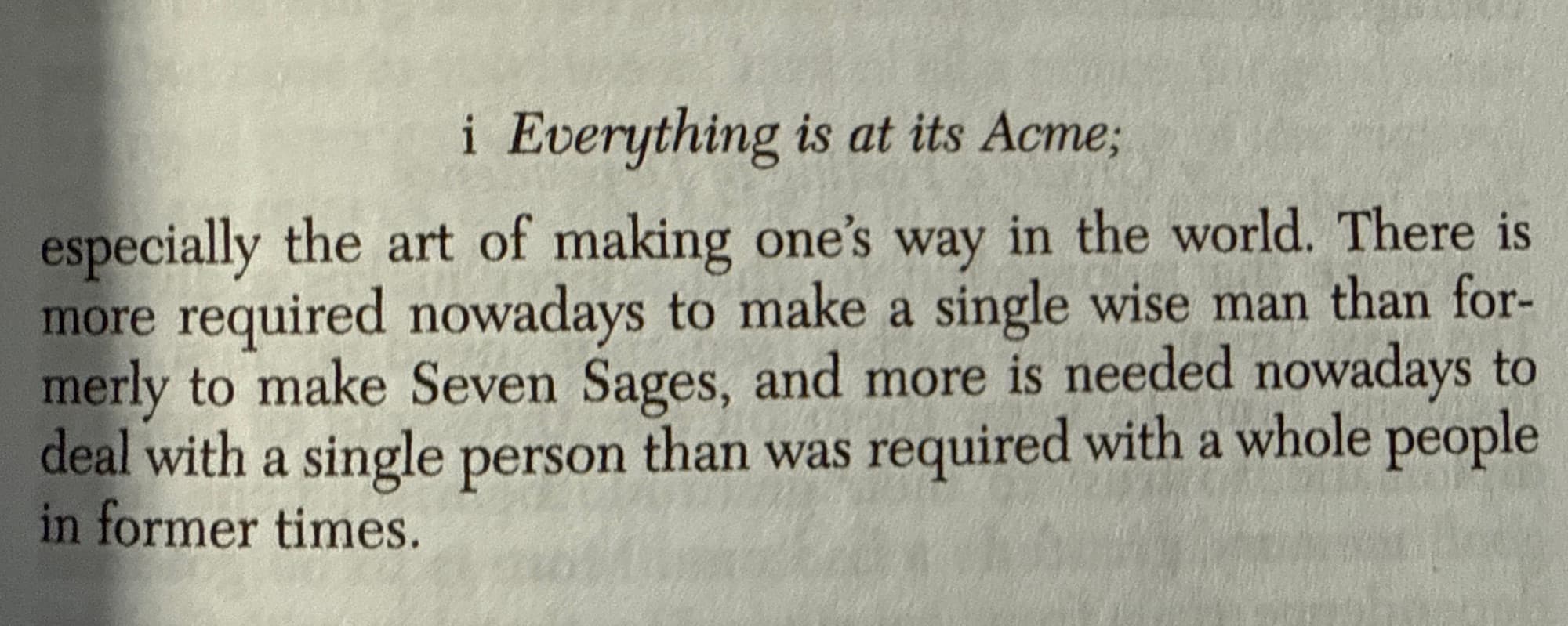
Everything is at its acme.
He means the world has already reached its peak. He does not write it as a compliment. He writes it as a warning, and then he gives two examples.
In ancient Greece, seven men were known as the Seven Sages. Everyone knew their names. Gracián says that in his own time, making one wise man took more work than all seven of them needed together.
The second example is the stranger one. He says there was a time when you could deal with a whole nation using plain honesty. In his century, one single person took more skill than a whole nation used to take.
Read those two together and you get his real claim. The world did not get worse. It got more crowded and harder to read, and the same result now costs more than it used to.
He was already late
Now look at the date. 1647. No electricity. No telephone. A letter took weeks to cross a country. And a man sitting in that world is already saying it moves too fast for the old rules.
Every generation says this. Usually that is a reason to distrust a claim. Here it works the other way. If people in 1647, in 1890 and today all report the same feeling, the useful conclusion is not that they were all exaggerating. It is that the ground moving is the normal condition, and the calm stretches are the exception.
So the interesting question was never whether this era is hard. It always is. The question is what separates the people who cross into the next version of the game from the people who stay behind in the last one.
Kodak did not miss digital
The most famous example in business history is usually told wrong.
Kodak built the first digital camera in 1975 and then, the story goes, protected film until digital ran it over. Willy Shih, who ran Kodak's consumer digital business as a senior vice president, says that version is false. Kodak's own 2005 SEC filings report it holding the number one unit market share position for digital cameras in the United States. In January 2012 it filed for Chapter 11.
Shih's explanation is the part worth keeping. Film had high walls. Coating and cutting it at scale was hard, and only two companies in the world could really do it. Digital ran on a general purpose semiconductor platform with modular parts anyone could buy. A good engineer could assemble a camera from components other people made.
So Kodak learned the new game and led it for two years. The trouble was that the new game had no walls in it, and Kodak was still built around walls.
Adopting the technology was never the hard part. Being built for the old economics was.
My father was early too
He was a trader in Istanbul and, for most of his career, ahead of the people around him. He adopted new things before they did.
He also tells me what information used to cost. Before the internet, chasing one specific fact could take a day. You went to a person, or an office, and then you waited for a call back. Knowing things was the business.
He fell out of the game anyway. Not because he refused to see what was changing, but because the rate of change went past the rate at which he could absorb it, and the thing his advantage rested on stopped being scarce.
I used to read that as a personal story. After Kodak I read it as the same shape at a different scale.
The scarce thing keeps moving
When I was starting out, getting clear and true information was still work. It was out there somewhere, but you had to hunt for it and then decide what to trust. Judgment about sources was worth something.
Today a twenty year old reaches almost anything in seconds. That killed the value of the hunt, and for a while the scarce thing became knowing what to ask and what to believe.
Then it moved again. We are past the point where you look something up and do the work yourself. Increasingly you state an outcome and something acts on your behalf. It reads, decides, calls another system and comes back with the thing done.
That is not a faster version of the last game. The unit of work changed. And when the unit of work changes, the skill that made you good at the old unit stops compounding, the same way Kodak's coating plants stopped compounding.
I watched who made it across
I have been inside this since January 2024. We have given AI services to 32 companies, and more than eighteen thousand people have used what we built. That is observation and not a study, and I want to label it before I use it.
Almost everyone starts in the same place, and they start well. They make the use practical. Real work, every day, until reaching for the thing stops feeling like an event. This step is worth doing and it is where the large majority stop. What a company gets from it is people who are faster at the jobs they already had. Nothing about the company has changed.
The next step is where the drop happens. You stop assisting yourself and hand work over whole. You take a process you own, you say what a good outcome is, you say where a human has to sit, and you let it run end to end.
Almost everyone fails here, and the reason is always the same. You cannot hand over a process nobody ever wrote down. The people who run it well are carrying it in their heads, and nobody has ever asked them to explain the parts they do not experience as decisions. Ask an experienced person how they handle a case and you get the clean version, the one in the manual. The valuable part is the other version. Why they overrode the obvious answer that one time. Which customer they call before quoting. What in a file makes them slow down without being able to say why. None of that is in your systems, because none of it was ever a field in a form. So teams reach this step, discover their documentation describes a company that does not exist, and quietly go back to the first step and call it adoption.
The last step is rare and it is the only one that changes what a company is. You stop adding intelligence to the shape you inherited and rebuild the shape. The question stops being where can we add AI to what we do. It becomes: if something can understand, decide and act here, how should this work be built at all.
Adopt, agentize, go native. That sequence is the strategy we run at Verti, so I am not neutral about it.
Kodak did the first two of its own era. It adopted digital and it sold digital better than anyone in its home market. It stayed a film company in how it was organised and how it made money, and the third step was the one that would have saved it.
My father cleared the first step of his era and I do not think the third ever occurred to him. He got faster at the job he already had, in a market that was about to stop paying for that job.
Gracián never told anyone to slow down. He assumed the world would not get simpler again, and then he wrote three hundred rules for living in a world like that.
He was right about the assumption. The three hundred rules are what he paid.
Sources
- The Real Lessons From Kodak's Decline. Willy Shih, MIT Sloan Management Review, Summer 2016. Shih was a Kodak senior vice president from 1997 to 2003 and president of its consumer digital business. His argument is that the failure was not blindness to digital but the collapse of entry barriers once imaging moved onto a modular semiconductor platform.
- Eastman Kodak Form 8-K, Q2 2005. SEC EDGAR. Kodak's own filing reporting the number one US unit market share position in digital still cameras. IDC put the 2005 share at roughly a quarter of the US market, an estimate rather than an audited figure.
- Eastman Kodak Company Commences Voluntary Chapter 11 Reorganization. SEC EDGAR, January 19, 2012. Case number 12-10202, Southern District of New York.
The claims in the last section come from my own work and are not measured. The Gracián translation is the Joseph Jacobs English edition of Oráculo Manual y Arte de Prudencia, first published in Spanish in 1647.

Comments